

About Wim
Wim Verhoeven is an artist and entrepreneur.
His work emerges at the intersection of material, technology and experience.
His practice is rooted in making.
Ideas are not developed to remain abstract, but to take form.
From his studio, he investigates how precision and craft, innovation and tradition, can reinforce one another.
The knowledge and techniques he developed through his entrepreneurial work are not a backdrop, but an active part of his artistic process.
His work is characterized by a natural, layered presence. Surfaces carry traces of action and attention, revealing a certain slowness—as if the work already holds a history before it is fully complete.
 |  |
|---|---|
 |  |
 |
This is where the creations began

In 2004, Wim founded one of the first 3D-printing companies in Belgium and the Netherlands.
From the outset, the studio operated at the intersection of technology and creation, collaborating closely with the art and design world.
Working with artists, architects and designers from both home and abroad, he developed in-depth expertise in digital fabrication processes and scale. That experience now functions as a natural instrument within his artistic practice.
For Wim, technology is not a theme but a tool, no more fundamentally different from a brush or a chisel: a means of translating inner perception into outward form.
In his work, Wim connects contemporary technology with older narratives, experiences and structures that continue to repeat within human existence: tension, growth, loss, transformation.
Not as illustration, but as an underlying layer.
The work does not seek explanations, nor does it offer answers.
It functions as a reflection, a mirror that gently dares to question us.
Precisely because art exists outside judgment and utility, insights can enter through the work in a softer, more honest way.
In this way, a field of tension emerges between the old and the contemporary, between the outer and the inner. The work invites slowness and reflection, without fixing or defining anything.

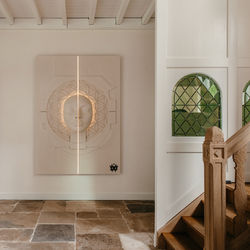
Light plays an essential role in Wim’s work, not as an addition, but as an active component of form.
Through light, movement, depth, and change emerge; the work responds to its surroundings and shifts along with the space.
Some works do not reveal themselves in a single glance, but unfold gradually. Patterns and structures appear and disappear, referring to orderings that feel both natural and cultural, without being fixed in meaning.
In a world where much seems understandable and controllable, wonder easily slips into the background. The work gently questions that assumption. Not to make us believe, but to make us look again.


