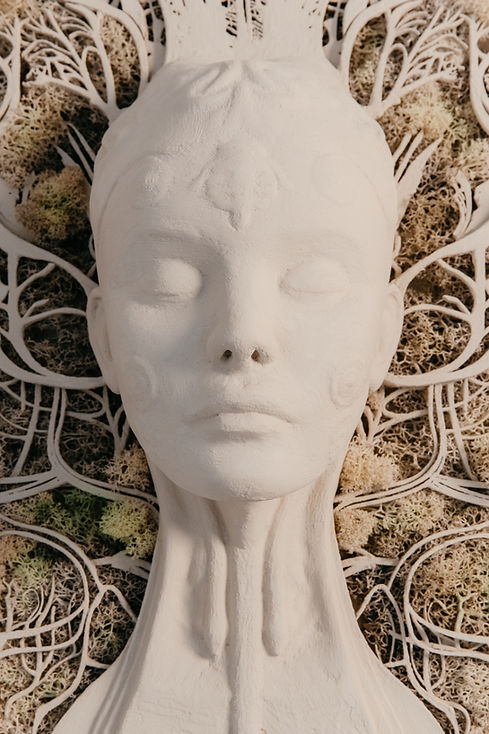
When understanding is no longer enough, who tells us what we feel?
I believe we are in the middle of something.
Not at the beginning, not at the end, but in a transition zone where past and future meet.
We know surprisingly little about the first civilizations. About cultures that left behind architectural and artistic traces that still cannot be fully explained today. Monumental structures, organically shaped stones, perfectly positioned and scattered across the globe. Their forms seem designed not "against" nature, but "together" with it. As if stone, landscape and humankind formed a single, thinking system.
Those civilizations seemed to view nature not as a raw material, but as a conversational partner. As an intelligence to be taken into account. Today, that idea is quickly dismissed as naive or vague, as if attention, attunement, and intuition no longer have a place in a mature worldview.
Yet that is exactly what we are missing.
Even with our current technology, we don't understand how these structures were made or how massive stones were moved across vast distances. And while we think this past is fixed, we continue to discover new layers. Scans beneath the Egyptian pyramids suggest hidden structures, deep underground, as if the earth itself harbors memories yet to be fully unlocked.
At the same time, we are rapidly moving toward a future in which rational thinking is increasingly outsourced. Artificial intelligence analyzes, decides, and predicts faster and more efficiently than we do. Technology is precise, but not embodied. It knows no rhythm, no seasons, no mortality.
In that process we risk losing something fundamental:
the ability to be open to what cannot be immediately measured or proven.
We've trained ourselves to distrust that domain. To dismiss anything not immediately explainable as vague, vague, or irrelevant. But what really happens when we close that door? Do we become more rational or simply poorer in experience?
Have we really become so closed off that we can no longer listen?
Not to nature.
Not to the body.
Not to that silent knowing that precedes language and logic.
My work is situated in that field of tension.
Between forgotten knowledge and unknown future.
Between technology and nature.
Between analysis and intuition.
I don't see art as an answer, but as a space for exploration. A place where deceleration is possible. Where questions are allowed to exist without immediate solutions. Where the so-called "airy-fairy" isn't dismissed, but explored...seriously, attentively, without cynicism.
Maybe being open isn't a weakness.
Maybe it's a skill we need to relearn.

What is still real?
What is still real?
Online we see everything, always.
But can we still trust our eyes?
or do we need to learn to feel again?
Where is technology taking us?
Towards a deeper connection
or to a greater distance from ourselves and nature?